Free Planning Poker by TeamRetro

Fast, unbiased story-point estimation for teams who want better sprint planning. Estimate together, reveal in real time, and keep momentum going. No sign up required.

Built with ♥️ by TeamRetro

TeamRetro helps scrum masters, product owners, and development teams run better retrospectives with ready-to-use templates, action items, and continuous improvement tracking—built for remote, hybrid, and in-person teams.

Simple, easy estimations for better sprint planning

Keep everyone aligned, reduce anchoring bias, and get to consensus faster.

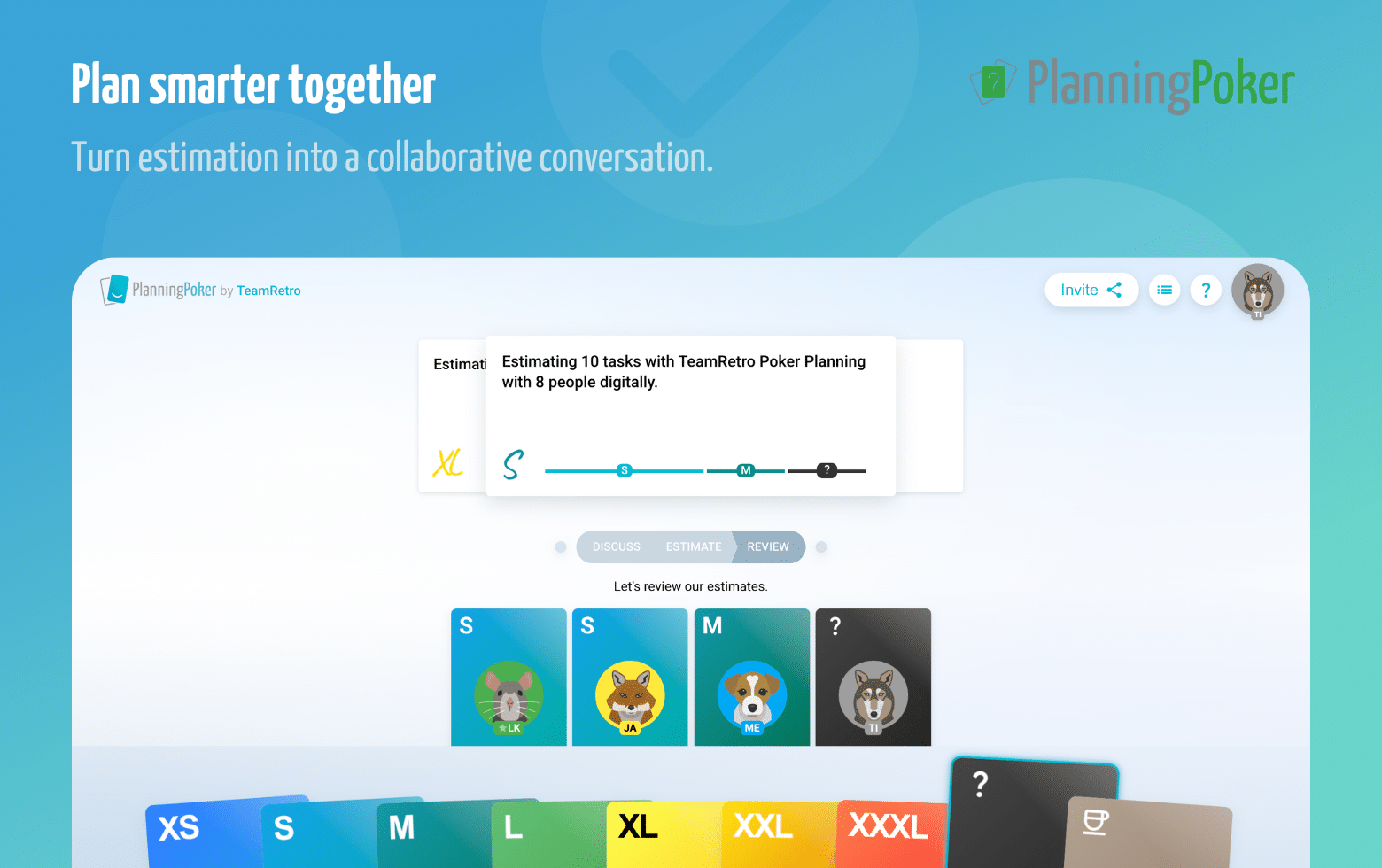
Add items for discussion

Use this phase to discuss the items to be estimated and allow people to ask questions before estimating.

Estimate items privately

Each player selects a hidden value card. Cards stay hidden
until revealed to avoid anchoring and bias.

Reach shared decision

All cards are revealed with a tally and team average. Discuss, re-vote, or agree on a final estimate.

Ready to go estimation card decks

Choose the scale that works best for your team. Whether you prefer classic fibonacci or simple t-shirt sizing, we’ve got you covered.

Scrum

Colorful scrum poker cards for online agile estimation in TeamRetro

Fibonacci

Colorful Fibonacci planning poker cards for agile estimation in TeamRetro

Sequential

Sequential planning poker cards for agile story estimation

Half Card

Half-value planning poker cards for agile sprint estimation

Power of Two

Power of two planning poker cards for agile story estimation in TeamRetro

T-shirt Size

Colorful t-shirt size planning poker cards for agile teams

Frequently asked questions

Everything you need to know about planning poker.

Planning Poker is an agile estimation technique where team members assign story points to user stories based on their complexity, effort, and uncertainty—helping teams plan sprints more accurately. It promotes team consensus and surfaces differing perspectives early.

Planning Poker is a simple, team-based way to estimate work by combining shared understanding and quick consensus.

  1. Pick a backlog item (user story/task) to estimate.
  2. Review the details: goal, scope, and acceptance criteria. Ask clarifying questions.
  3. Choose your estimate privately using the agreed scale (commonly Fibonacci: 1, 2, 3, 5, 8, 13…).
  4. Reveal estimates at the same time so no one influences others.
  5. Discuss differences if estimates vary—especially the highest and lowest—to uncover risks, assumptions, or missing details.
  6. Refine the item if needed (clarify requirements, note assumptions, or split the work).
  7. Re-estimate and repeat until the team reaches a reasonable agreement.
  8. Move to the next item and keep going until you’ve estimated what you need.

Wide variance signals misunderstanding or hidden complexity. Have the highest and lowest voters explain their reasoning—often they’ve spotted risks or assumptions others missed. Discuss, clarify, and re-vote until the team aligns.

If estimates vary, the team discusses the reasoning behind their points. This often uncovers misunderstandings or missing details in the user story, leading to better alignment.

To ensure a successful planning and estimation session with your team:

  1. Prepare the work first: Make sure each item has a clear goal, brief description, and acceptance criteria.
  2. Keep stories small: Split large items so they’re easier to understand and estimate.
  3. Align on what “done” means: Confirm scope, assumptions, and any dependencies before voting.
  4. Use a consistent scale: Stick to one estimation scale (e.g., Fibonacci) for the whole session.
  5. Vote simultaneously: Have everyone reveal their estimates at the same time to avoid influencing each other.
  6. Discuss gaps, then re-estimate: If estimates vary widely, let the highest and lowest explain why, clarify, then vote again.
  7. Timebox discussions: Park deep technical debates as follow-ups so the session keeps moving.
  8. Capture notes: Record key assumptions, risks, and action items directly in TeamRetro so everyone stays aligned.

No account is required for instant use and allows you to reuse the same room number for future planning and estimation sessions.

Related blog articles

Agile estimation, sprint planning, and team collaboration.
Blue and white Free Planning Poker tag badge in TeamRetro

Ready to estimate in minutes?

Start a Planning Poker session and invite your team. No sign-up required.

Still have questions? SCHEDULE A DEMO